

Elsevier is a global leader in scientific publishing and information analytics, serving the research, healthcare, and technology sectors with trusted content and advanced digital tools. With a history dating back to 1880, the company has evolved into a powerhouse of structured scientific data, supporting breakthroughs across disciplines including life sciences, chemistry, materials science, and engineering.
Through platforms such as ScienceDirect, Scopus, and Reaxys, Elsevier provides access to one of the world’s most comprehensive collections of peer-reviewed literature, experimental data, and chemical intelligence. Alongside its publishing legacy, Elsevier invests heavily in data science, artificial intelligence, and digital infrastructure to empower discovery and accelerate innovation in both academic and industrial contexts.
This combination of domain authority and data-driven capability makes Elsevier a key enabler of complex problem solving in sectors where research meets real-world application.

Challenge:
Scientific discovery increasingly depends on navigating complex, fragmented data ecosystems. Yet the very scale and diversity of modern research outputs has made meaningful insight harder to access. For Elsevier, with its vast corpus of structured and unstructured scientific content across chemistry, biology, and materials science, a central challenge had emerged:
How do we enable researchers and industrial chemists to rapidly uncover novel molecular relationships and interactions – securely combining their proprietary data with Elsevier’s own?
Traditional search and retrieval methods were no longer sufficient. Chemists asked questions like “What is the effect of X on Y?” or “How do I make…?”. But the answers were buried across siloed datasets, inconsistent formats, varied ontologies, and restricted-access documents. Manual correlation was slow, error-prone, and incapable of scaling to the volume or complexity of available knowledge.
Elsevier needed a solution that could not only unify and normalise this data semantically, but also operate autonomously, generatively and intelligently, sifting through disparate content, identifying previously unseen relationships, and surfacing patterns and insights that human researchers may never have found. The ambition was to move beyond static search to a system capable of intelligently delivering genuinely novel outcomes, accelerating innovation in domains from pharmaceuticals to industrial chemistry and advanced materials.
The solution also had to respect data permissions, handle entitlement boundaries, and present results in a way that aligned with the real-world workflows and mental models of domain experts, enabling rapid adoption and meaningful action.
Approach:
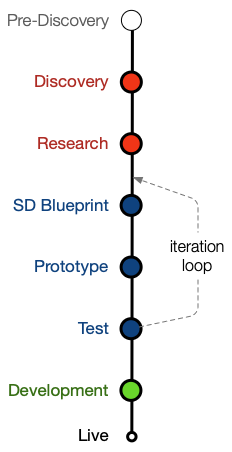
To address Elsevier’s challenge, I applied a structured, multi-phase approach rooted in research, problem framing, user insight, business goals, system architecture, and iterative AI service design:
Foundation for Scale & Expansion Delivered a robust, modular platform design capable of expanding beyond chemistry – applicable to any molecular or material research domain. Designed for continuous learning, feedback integration, and scalable enrichment.
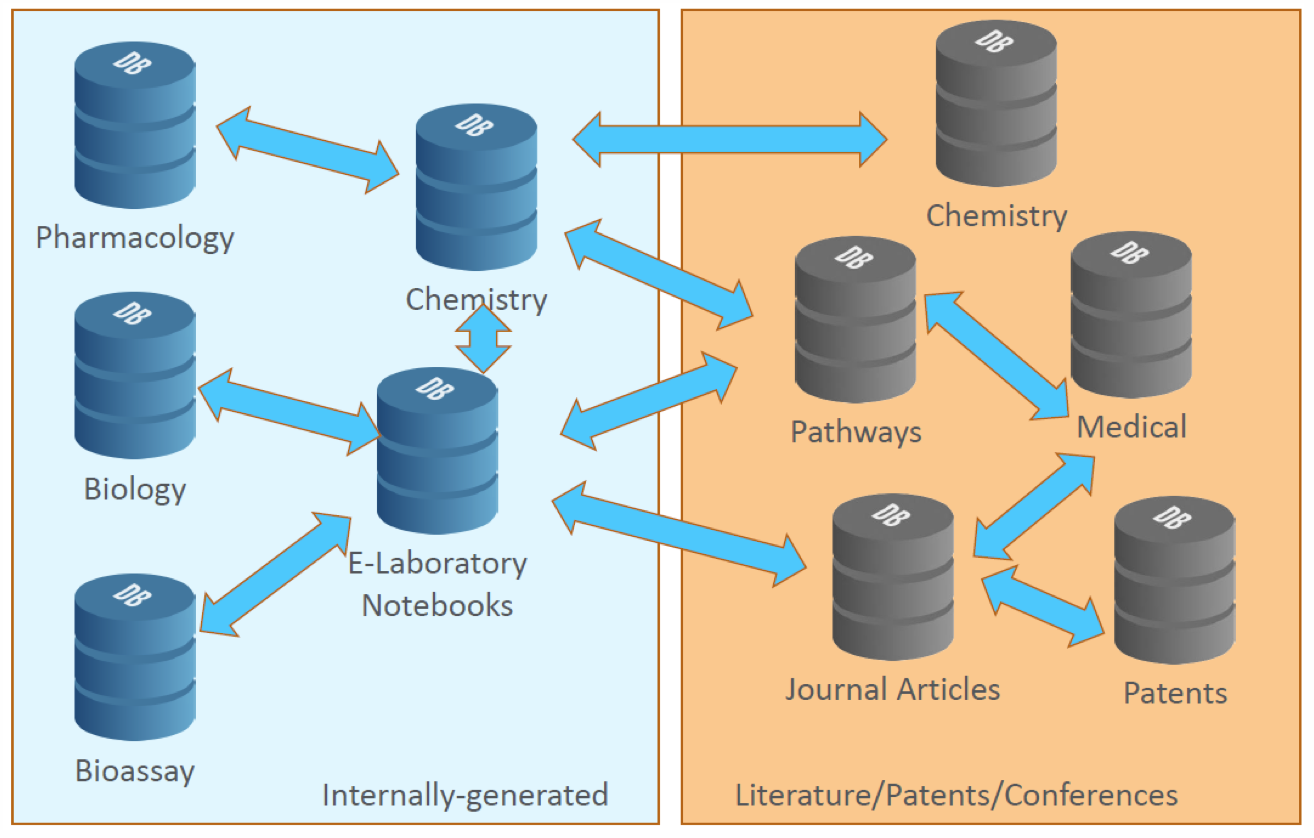
Problem Definition in Context Mapped Elsevier’s organisational data landscape and stakeholder needs, identifying the root challenge: enabling discovery from fragmented, inaccessible, and unstructured molecular data, at scale, and across multiple industries.
User & Domain Immersion Conducted in-depth analysis of chemist workflows, information-seeking behaviours, and query types (“How do I make…?”, “What is the effect of X on Y?”). This revealed a critical gap between available data and usable insight.
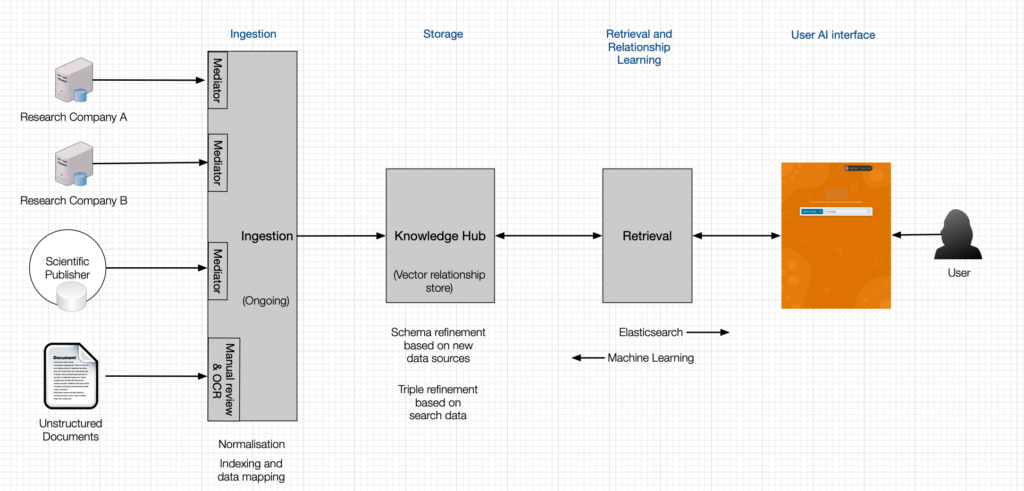
System Mapping & Data Strategy Audited Elsevier’s internal content ecosystem and potential client data types. Mapped a pipeline to ingest, normalise, and semantically enrich both structured and unstructured sources – enabling true cross-source synthesis.
AI & UX Service Design Defined the architecture for an interactive, turn-based AI experience. Created a system that surfaces inferred relationships, supports refinement cycles, and keeps the chemist in control – blending machine intelligence with human judgement.
Semantic Modelling & Retrieval Framework Collaborated with NLP and ML experts to implement a domain-specific triple store, enriched via machine learning and manual curation. Ensured that AI-derived outputs were explainable, relevant, and scientifically grounded.
Iterative Validation & Interface Design Prototyped and tested search interactions, feedback loops, and result presentations. Refined the UX to align with chemist cognition – enabling rapid pattern recognition, provenance tracking, and trust in outputs.
Outcomes and Value:
The solution delivered for Elsevier broke new ground in how scientific and industrial research organisations extract insight from multi‑modal chemical data. It combined generative AI, semantic modelling, and a user-centred experience to produce outcomes far beyond mere search and well before LLMs came to the fore.
Key Outcomes and Value Themes
- Augmented Discovery & Novel Solutions Across Industries
- The system empowered users to uncover previously unseen relationships, mechanisms, and compound interactions – enabling new solution pathways and discoveries in domains including pharmaceuticals, advanced materials, and industrial chemistry.
- Turn‑Based AI Interaction & Human-in-the-Loop Design
- Rather than delivering just text based search results, the UX supported turn‑based AI cycles: chemists pose a query, the system proposes hypotheses or relationships, the user refines or approves, then the AI adjusts further. This interaction paradigm ensured progressive refinement, user trust, and alignment with expert intent, while benefiting from autonomous pattern recognition.
- Accelerated Insight & Time Savings
- Tasks that previously took days or weeks (or were not possible before) of manual synthesis, correlation, and cross-referencing were compressed to minutes.
- Users could explore “what-if” hypotheses dynamically and follow leads in real-time rather than waiting for training, script runs or batch jobs.
- Data Synergy & Secure Integration
- Clients could combine their proprietary data with Elsevier’s scientific corpus in a context-aware, permissioned architecture, creating expanded intelligence and unlocking deeper insights without compromising data governance
- The integrated data environment allowed cross-domain correlation (e.g., linking process chemistry, materials data, reaction databases) that would not have been possible in siloed systems.
- Scalable Intelligence & Continuous Learning
- The underlying models, taxonomies, and pipelines were built for adaptability: new datasets, ontologies, or scientific sub-domains could be added, and feedback loops refined the system over time.
- As users engaged across domains, the platform’s inference models become richer, improving insight quality and broadening applicability.
- Human‑Centred AI & Usability
- The interface was crafted to match chemist workflows with domain-specific language: familiar query forms, visualisations of relationships, interactive filtering, and result provenance.
- Explanations of inferred relationships, confidence metrics, and the ability to “drill down” into supporting documents promoted user trust and adoption.
- Strategic Differentiation for Elsevier
- The project signalled a shift for Elsevier: from being a repository and indexer of scientific knowledge to a provider of intelligent discovery services, positioning them as a partner in outcome-oriented R&D, not just a data vendor.
- This opened pathways for value-added services, new revenue models, and deeper embedding into client research pipelines.
